
Traditional Loom Weavers in Myanmar
Travel note: Since the 2021 military coup, parts of Myanmar have seen armed conflict, and the March 2025 earthquake centred near Mandalay and Sagaing damaged many temples and other sites. Before you go, check your government’s travel advisory and confirm with a local guide which areas and sites are currently open and safe to visit.
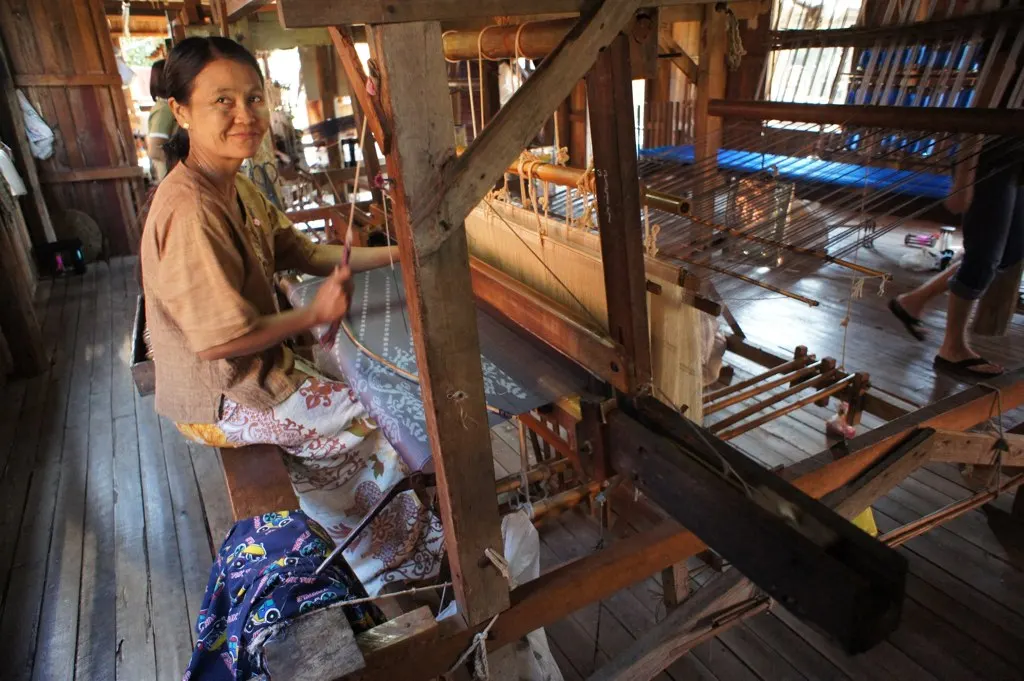
Traditional loom weaving is the antithesis of fast fashion production. All elements of the textile, from creating the threads to the set-up of the loom, are done by hand - it is a true skill to master. One of the first things you notice in a traditional loom workshop is the noise. It's a heavy clacking sound coming from the weavers as they use pedals to move the threads on the wooden frames. The looms are entirely human-powered, which is a rare sight in this day and age. It was especially interesting to see how textiles are engineered from scratch. How textiles are made has largely been overlooked in recent times, since the norm is to buy the finished product, and never know where, or even how it was made. Earlier, Myanmar weaving businesses were passed down through generations as family businesses. But now, weaving businesses are surviving on a manageable scale in rural areas, including the Chaungzone Township of Mon State.
Handicraft is a type of craft where people make things using only their hands or basic tools. The items are usually decorative and have a particular use. Usually, the term refers to traditional methods of making things. The items often have cultural or religious value. The traditional arts and crafts derive from the cottage craft in the period of natural economic development, in order to meet the personal needs of producers. At that time, the works of arts and crafts had functions of production and consumption and strong aesthetic value. Handicraft is very important because it represents culture and tradition. It promotes the heritage of a country through the use of indigenous materials and it preserves traditional knowledge and talents. Traditional art is a part of the culture of a group of people, skills, and knowledge of which are passed down through generations from master craftsmen to apprentices.
Not all Myanmar weaving is done on large wooden frame looms. In Chin State, in the west of the country, women traditionally weave on simple backstrap looms, with one end of the warp tied to a post and the other to a strap around the weaver’s back. Chin textiles are woven from cotton or silk, traditionally coloured with indigo and other plant dyes, and their patterns and motifs reflect Chin culture and the mountain landscape. Girls traditionally learned to weave from their mothers, making cloth for their dowry and to keep as family heirlooms, and these textiles are still worn for special occasions.
Today most Chin weavers are women working at home alongside farming and household duties, and fewer young women take up the craft. Social enterprises such as Yoyamay have worked with Chin weavers to train younger weavers and find new markets for their cloth. Note that Chin State has been one of the areas most affected by armed conflict since 2021 and is generally not accessible to visitors; Chin textiles can sometimes be found in shops in Yangon and other cities.
In Myanmar, people wear traditional clothes, prominently acheik longyi (skirt) in events such as weddings, novitiate ceremonies, and national gatherings. When you find a lady wearing acheik longyi abroad, she is certainly from Myanmar. Myanmar people regard acheik textiles as an important aspect of the identity of the people of Myanmar, representing the tradition and practice of a thriving culture.
Read more:Hiking Routes in Myanmar
Luntaya acheik is an indispensable item that projects the social status of women. The term lun means shuttle and taya means a hundred. Acheik, on the other hand, means connect, and it is also the term for tapestry weaving methods. So luntaya acheik is a kind of woven cloth with threads crossing under and over each other on plain textile using many shuttles. Acheik textiles have flourished since the nineteenth century CE. During the ancient period, acheik was used for royal costumes; ordinary people were not allowed to wear acheik. The highest-ranking officials, royal services, and merchants could only wear acheik if the king rewarded them. Until now, acheik workshops are mainly based in Amarapura, Sagaing, and Mandalay in upper Myanmar.
For the weaving process, three or four raw silk threads are twisted tightly with the aid of a machine for tautness and smoothness. After that, silk-woven faces are removed by washing in boiling nut soap liquid. This step helps the fabric become softer than ordinary silk thread. While boiling the silk, colors can be added to dye the thread. And then, the dyed threads are washed with water and placed under the sun to dry. For weaving, the silk threads are kneaded onto bobbins, and then the bobbins are attached to the loom; the weavers will then weave the desired acheik patterns. Between one hundred and three hundred small bobbins are used to weave intricate and complex acheik designs. Traditional acheik have a lot of names according to the designs, depending on the color usage and the number of small bobbins. There are fifty-two kinds of classic acheik designs, and they are expensive as it takes many days of manual labor to produce acheik textiles.
Nowadays, cotton and silk are mixed and Acheik designs are modified to produce cheaper versions by weaving machine. Though handmade acheik textiles are expensive, Myanmar ladies proudly wear this classic design textile pattern for both special social and religious occasions. Since Myanmar people have worn acheik designs during special events and ceremonies since ancient times until today, Myanmar acheik continues to be a living heritage. The weaving practitioners relentlessly transmit their knowledge and skills to the young generation.
Setting up the Looms
Setup is usually the hardest part, as each thread (the warp) is aligned onto the loom through an eyelet and comb. This is a slow and painstaking process to load all the threads to create a fabric of around 1m in width. It can take several people to help complete the setup. For more intricate designs, each thread needs to be arranged technically to allow for the particular pattern to be achieved.
Weaving
The wooden shuttle is filled with a bobbin. This is usually of a different color thread if the weaver is creating a pattern. The shuttle will carry the weft threads (the threads going in the opposite direction which creates the weave) back and forth across the loom. The weaver uses two pedals underneath the loom to operate the frames. Each frame holds half of the eyelets so as one frame pulls up, the other pulls down, and the shuttle runs in between these. The weaver pulls a lever to control the shuttle. After this movement, the weaver then pulls the comb forward to close the threads into the woven section. The bobbin in the shuttle can be changed according to which color is needed. For an intricate pattern the weaver will have to change the shuttle often. These already have the correct color bobbin inside and are labeled to help speed up the weaving process. The weaver uses the pedals and shuttles in repetition until the textile is complete.
Benefits of traditional loom weaving:
- No carbon emissions
- Low waste - only the threads needed are loaded to the loom
- Revives traditional handicraft production
- Weavers do not need to rely on electricity supply to work
- Each piece is unique according to the texture of the threads
- The loom itself is handmade and lasts for many years
It is clear that traditional knowledge of weaving remains strong in the area, but this knowledge, sadly, is fading rapidly as the intricate beauty of the weaves gradually disappears with the passing of skilled master weavers. There are, in fact, constraints for restoring the weaving culture’s ancestral splendor. The most tangible obstacles include a lack of market opportunities combined with the poor availability of raw materials, such as cotton and silk. Another major constraint is the availability of free time for weaving, due to involvement in other priority income generation activities. But most importantly, the passing of master weaving skills from mother to daughter is not economically attractive now. In addition, the village men are not as supportive of the art as they could be, due to the opportunity cost of time for more remunerating activities.
Read more:Food culture in Myanmar
Cover photo: Esme Vos, CC BY 2.0, via Wikimedia Commons
Comments
Be the first to leave a comment.
Leave a comment
Related posts
10 Reasons Why You Should Visit South Korea
One of the most exciting destinations to visit after the coronavirus pandemic is South Korea. This is a magical country that has kept its culture, traditions, and values alive throughout the years. Its distinct cuisine, modern entertainment, and signs of ancient civilizations place it among the best
Apr 13, 2021
Celebrating Lunar New Year in Taiwan: Traditions, Taboos and Etiquette You Need to Know
Chinese New Year is a main holiday in China and has strongly influenced lunar new year celebrations in East Asian countries, including Taiwan. If it is your first time in Taiwan during Chinese New Year, this "taboos and etiquette" guide on norms and customs would surely come in handy. It is always e
Jan 21, 2021
Traveling to Southeast Asia: Your Ultimate Southeast Asia Coffee Guide
From small mini stands, hip cafes to motorcyclist vendors, coffee in Southeast Asia is presented in different forms yet they remain the same with their sweet, creamy and sometimes bitter taste to let you start your day or wake you up in a lazy afternoon.
Jan 2, 2021