
Fisherman Culture of Inle Lake
Have you ever wondered what it’s like to live above water, on a lake? What life would be like surrounded by water. People who live on the Inkle lake have formed a culture of living on water.
Before you go: since the 2021 military coup, parts of Myanmar have seen armed conflict, and the March 2025 earthquake centered near Mandalay and Sagaing damaged many temples and buildings. Many governments advise against travel to some or all of the country. Check your government’s latest travel advisory, and confirm with a local guide which places are currently open and safe to reach before you plan your trip. Fighting has also affected parts of southern Shan State around Inle Lake in recent years, so ask locally whether the lake and the roads to it are safe to visit.
Have you ever wondered what it’s like to live above water, on a lake? What life would be like surrounded by water. People who live on Inle Lake have formed a whole culture of living on water, and the lake’s fishermen have become one of Myanmar’s most famous sights. From leg-rowing fishermen to ancient monasteries and vibrant floating markets, Inle Lake is a must-visit destination for anyone visiting Myanmar!
Apart from the famous Bagan or Mandalay, exploring Inle Lake by boat should be a priority when visiting Myanmar. Inle Lake has long been popular with foreign visitors and it’s easy to see why: the scenery is breathtaking and it is surrounded by nature. Inle Lake, a freshwater lake located in the Nyaungshwe Township of Taunggyi District of Shan State, part of Shan Hills in Myanmar. It is the second largest lake in Myanmar with an estimated surface area of 44.9 square miles, and one of the highest at an elevation of 2,900 feet. During the dry season, the average water depth is 7 feet, with the deepest point being 12 feet. During the rainy season, this can increase by 5 feet
The people of Inle Lake, live in four cities bordering the lake, in numerous small villages along the lake's shores, and on the lake itself. The entire lake area is in Nyaung Shwe township. The population consists predominantly of Intha, with a mix of other Shan, Taungyo, Pa-O, Danu, Kayah, Danaw and Bamar ethnicities. Most are devout Buddhists and live in simple houses of wood and woven bamboo on stilts; they are largely self-sufficient farmers.
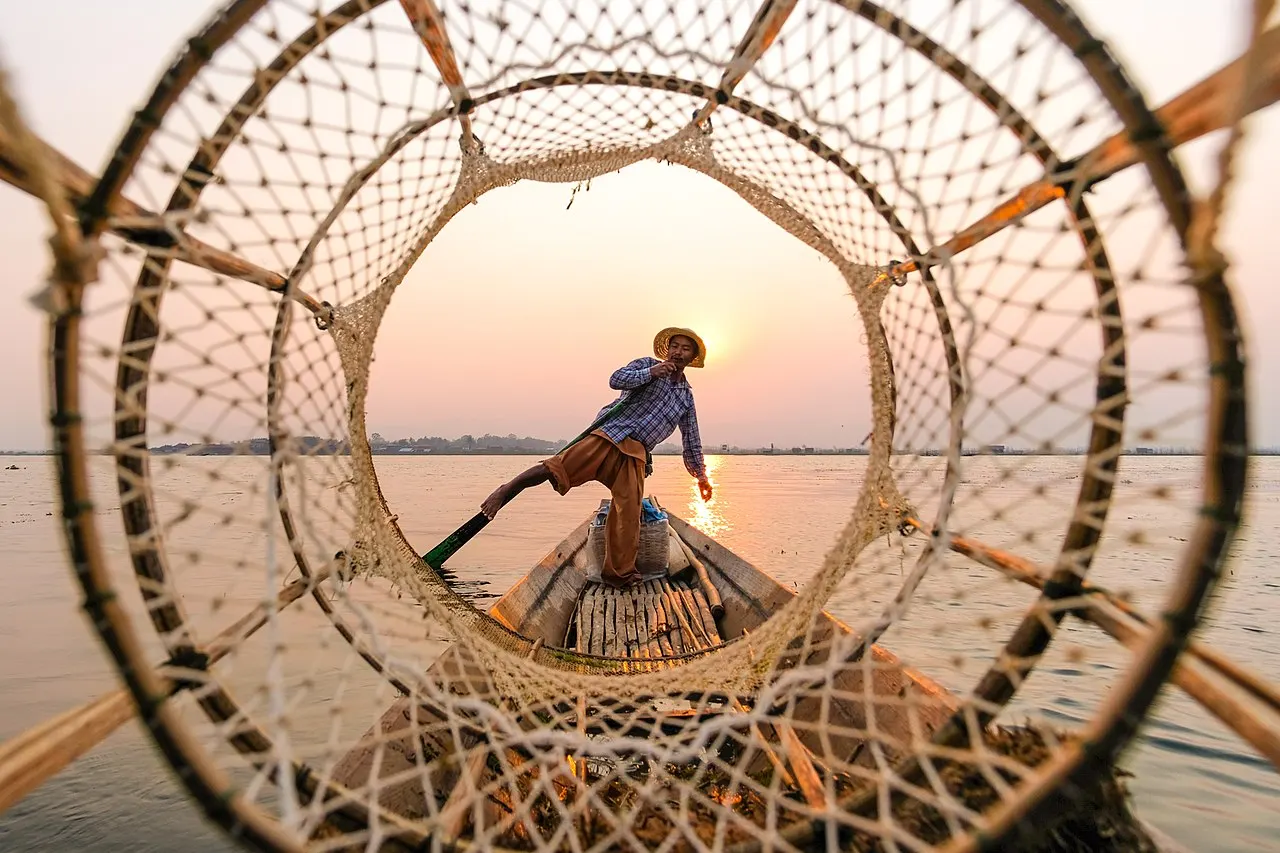
Transportation on the lake is traditionally by small boats, or by somewhat larger boats fitted with single cylinder inboard diesel engines. Local fishermen are known for practicing a distinctive rowing style which involves standing at the stern on one leg and wrapping the other leg around the oar. This unique style evolved out of necessity as the lake is covered by reeds and floating plants, making it difficult to see above them while sitting. Standing provides the rower with a view beyond the reeds. However, the leg rowing style is only practiced by the men. Women row in the customary style, using the oar with their hands, sitting cross legged at the stern.
Complete villages are built in the water. The houses stand on tall wooden stilts, ready for the higher water that comes with the monsoon. Everyday life is very busy around these villages. Hundreds of small motor boats and paddle boats are cruising the canals, fishermen are everywhere, looking for their daily catch, peasants are collecting seaweed to fertilize their gardens, vendors sell their goods from their boats. Many women do their chores on the stairs of their houses: washing clothes, dishes or even themselves and their children in the water of the lake. Bigger kids swim and play in the water, asking the boats passing by to splash water over them with the propeller of the engines. In between the villages you can always point out – and visit if you like – pagodas, monasteries and stupas, which make the view even more stunning.
And there is of course the unmissable romantic sunset over Inle Lake! Beautiful colors, the water is smooth like silk, birds gather to get ready for the night. And suddenly the leg rowing fishermen appear to show their acrobatic skills with their cone shaped net, using the paddle to turn and move the boat with one leg only. And behind them the Sun slowly descends.
Fishermen
Out in the wider stretches of the lake the fishermen are at work in the intense sunshine. Their unique method of rowing with one leg is famous and their conical nets fascinating to see as well. The men know where the fish will be and position the basket like cone in the water, agitating it to stun the fish, and then hooking them into a net. These are placed in baskets and transported live to tanks under the houses. Keeping the fish alive keeps them fresh until they are eaten or sold. Children on the boats learn all the tricks of the trade and eagerly watch as the nets are raised.
Village life on the lake
As human beings are social creatures, there must be villages around the lake. Huge woven baskets are suspended from the shoulders of men and women as they walk along the paths towards the market. The local market rotates between five sites around the lake, so somewhere on Inle Lake there is a market every day, and it is quite a community event. The bright orange turbaned ladies had walked for three hours from the hill tribe areas to trade green tea for fish which they took back up to their villages. There is a riot of color from the spice stalls where women look for their cooking ingredients. There are no gas stations here and so a lot of the fuel is sold by the side of the road, ready to be poured into engines.
Floating gardens on the lake. Why waste the huge source of water right in front of you? People who live on Inle Lake grow floating gardens on the lake, and the area is one of the largest vegetable-producing areas in Myanmar, and the reason became clear when the pungent and aromatic scent of garlic, and tomato plants filled the air. These were the Floating Gardens of Inle Lake where rows of fruits and vegetables were being cultivated. Water hyacinth roots had been gathered as they clogged up the waterways. Cucumber, eggplant and tomato all makes their way to local markets and towns bringing in much needed income for the villages on the lake.
Boat tour tips
You’re likely already aware that boat trips on Inle Lake are the most popular things to do in the area. This is due to the fact that life at Inle Lake is largely built on the lake itself. If you can help it, we highly recommend an Inle Lake sunrise boat trip. Leaving early will mean you will catch the best light as you visit the pagodas and spot the authentic Intha fishermen on their morning trips. Also, starting early will mean you will avoid the hot Burmese sun, which is anything but pleasant on an uncovered wooden boat in the middle of the hot season. Since you’ll be wanting to leave at first light, it helps to have a boat tour booked and ready to go. The day before is fine. If you want to catch a glimpse of the authentic Intha fishing lifestyle, let your boat driver or guide know in advance and they won’t pull up in front of the posing fishermen.
It goes without saying that tourism money should go straight back into the pockets of local people, so research and book a tour that is run and delivered by locals. Before you lock in and agree to an Inle Lake boat trip, make sure you ask what is included in the trip in advance. It helps a bit with bartering when you know what to expect in advance. Here is a small list of things to look out for during your boat tour:
- Phaung Daw Oo Pagoda – a beautiful monastery
- Ywama Village – local floating market
- Inn Dein Pagoda – ancient Buddhist site
- Maing Thauk – bamboo-stilted village
- Silk and lotus weaving shops
- Cigar rolling shop
- Weaving shops of the Kayan (Padaung) women known for their neck rings; many visitors find these “long-neck” stops uncomfortable, so if you go, treat it as a visit to a workshop, ask before taking photos and buy directly from the weavers
- Nga Phe Kyaung – an old wooden stilt monastery once famous for its “jumping cats”
Cover photo: Benh LIEU SONG (Flickr), CC BY-SA 4.0, via Wikimedia Commons
Comments
Be the first to leave a comment.
Leave a comment
Related posts
10 Reasons Why You Should Visit South Korea
One of the most exciting destinations to visit after the coronavirus pandemic is South Korea. This is a magical country that has kept its culture, traditions, and values alive throughout the years. Its distinct cuisine, modern entertainment, and signs of ancient civilizations place it among the best
Apr 13, 2021
Celebrating Lunar New Year in Taiwan: Traditions, Taboos and Etiquette You Need to Know
Chinese New Year is a main holiday in China and has strongly influenced lunar new year celebrations in East Asian countries, including Taiwan. If it is your first time in Taiwan during Chinese New Year, this "taboos and etiquette" guide on norms and customs would surely come in handy. It is always e
Jan 21, 2021
Traveling to Southeast Asia: Your Ultimate Southeast Asia Coffee Guide
From small mini stands, hip cafes to motorcyclist vendors, coffee in Southeast Asia is presented in different forms yet they remain the same with their sweet, creamy and sometimes bitter taste to let you start your day or wake you up in a lazy afternoon.
Jan 2, 2021